
Delta-DOR SW Correlator
17/06/2023Arpsoft Projects
IDE-ONE
Client:
European Space Agency (ESA)
Partner:
Sapienza University of Rome, Thales Alenia Space Italia (TAS-I), BAE systems
Technologies:
Python, Fortran
Tag:
TT&C, Deep Space Exploration, Mathematical Models
Services:
Deep Space Ground Station Consultancy



Overview
Accurate navigation stands as a cornerstone in the success of space missions, playing a pivotal role in various mission aspects.
Whether it's delivering a lander to its designated location, achieving the desired orbit, or reconstructing spacecraft positions for scientific observations, the significance of precise orbit determination cannot be overstated. Furthermore, having a timely and precise orbital solution provides mission designers with the ability to optimize the propellant budget, ensuring efficient resource utilization and resulting in crucial mass savings. This becomes especially pertinent for planetary missions that rely on multiple flybys to reach their intended targets.
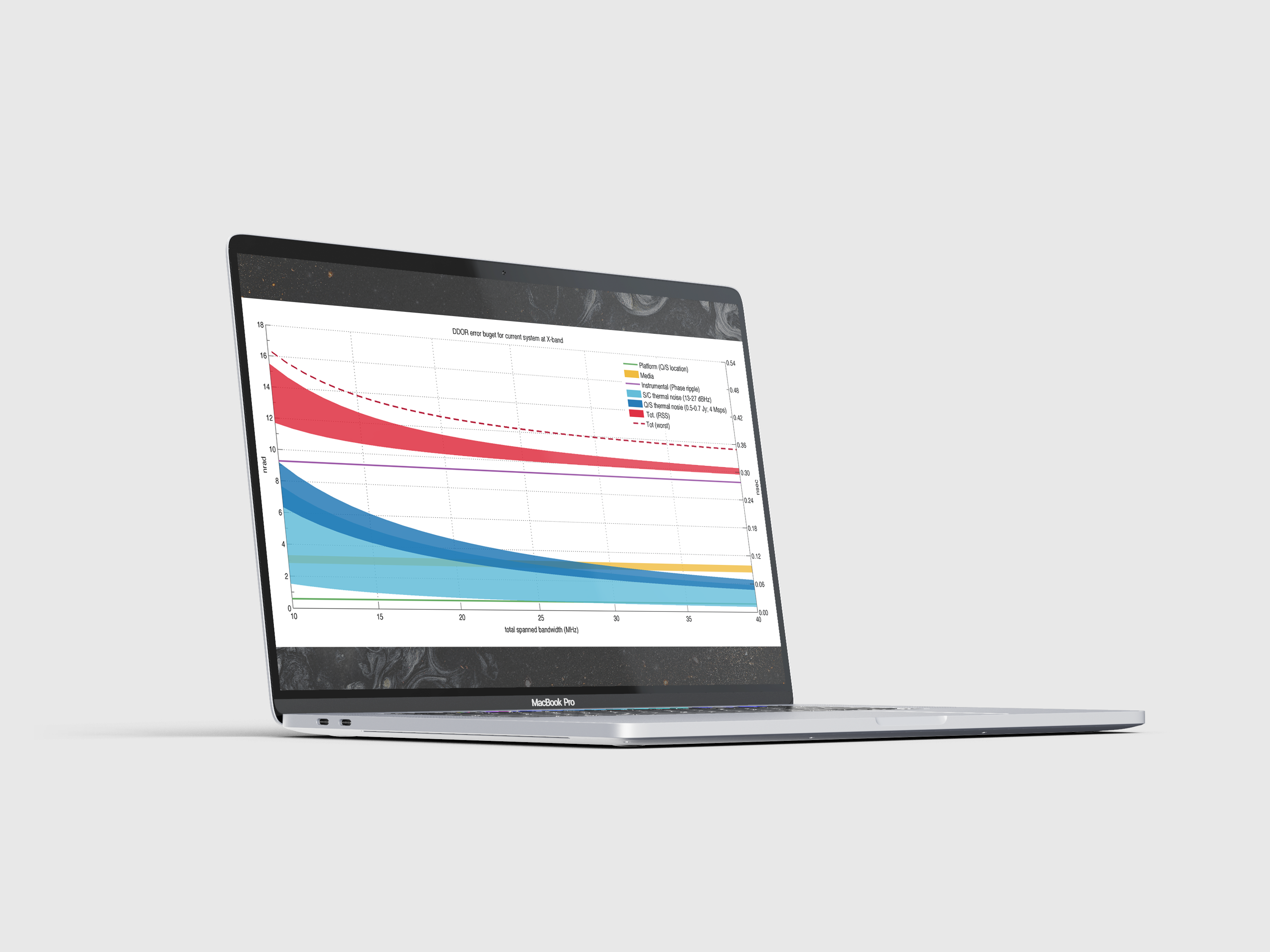
In light of these considerations, Sapienza University of Rome, in partnership with Arpsoft , Thales Alenia Space and BAE, conducted in 2014 a study focused on enhancing the European Space Agency's (ESA) Delta-Differential One-way Range (DDOR) system. The ambitious goal of this study is to improve the system's accuracy to at least 1 nrad (nanoradian).
Achieving such precision involves a series of corrective actions aimed at mitigating the adverse effects induced by various error sources. The overarching aim is not only to meet the stringent requirements of upcoming ESA exploration missions such as INSPIRE and MPL but also to enhance the navigation capabilities of ongoing missions like BepiColombo and JUICE.
In essence, this collaborative study serves as a testament to the commitment of these organizations to advance space exploration by refining navigation technologies, ensuring that future missions navigate the cosmos with unprecedented precision and efficiency.

Clients and Partners
Over the span of a decade, Arpsoft has had the privilege of collaborating with and providing services to a diverse range of international entities. These include prominent players in the space industry, esteemed space agencies, renowned universities, and esteemed national institutions.